

During my PhD, I wrote a paper on how ML models depend on good data (2019). In it, I analyzed model performance on high quality and low quality labels by artificially increasing the level of errors (noise) on a simple medical task
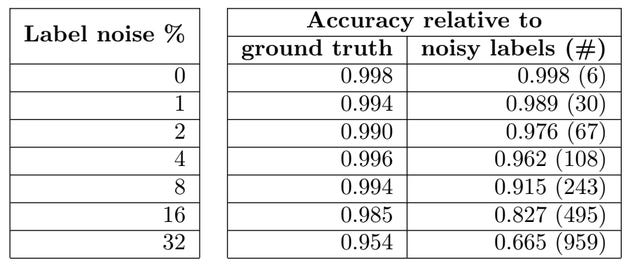
What we’ve seen was, models could handle label errors during training and learn from the overall momentum of the data. You can see that in the table above, if you look at accuracy relative to ground truth, it stays high for all noise levels. Where ~1/3 of the data was incorrectly labeled, models learned to do the task ~19/20 times. But when the same models are using the noisy data to make decisions, they flopped big time. They were wrong ~1/3 times.

So in ecom terms, if you don’t have correct catalog data, your products won’t get shown to right audiences. The performance of your store is going to be low and you won’t know why.
For example, the models that optimize your store performance will learn who buys a jacket. But if you incorrectly categorize a cardigan as a jacket, these models will show this cardigan to jacket buyers. When meta knows someone is into buying a jacket (trust me they do!), it will show your cardigan to that person.

This applies to all the models behind your recommenders, filters, search. It applies when an LLM discards your cardigan when the shopper is talking about which jacket to buy. It applies when shoppers are looking for outerwear in Google. It is everywhere, it’s just very difficult to see.
And imagine a shopper, who opened your store looking for a jacket, clicked on your jackets category, to see a cardigan. That’s a reason to bounce that you could have prevented.
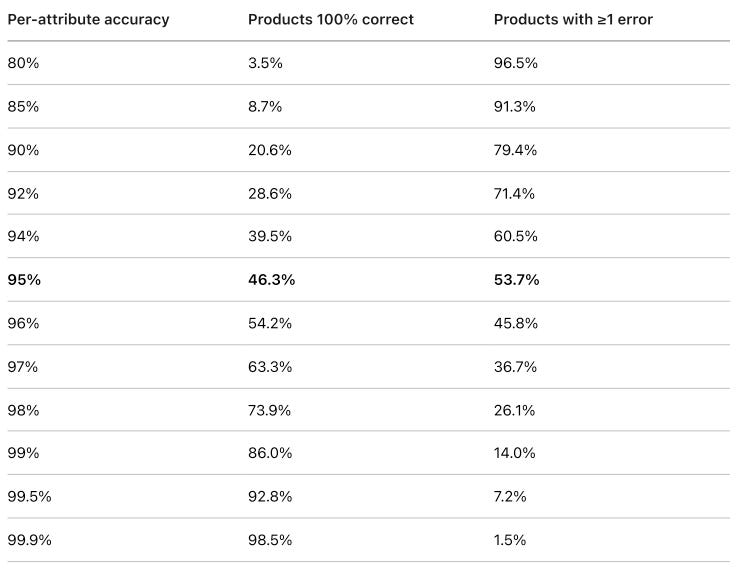
If you think about it, product data has many different angles. It ranges from category, to occasion, to color, to pocket style. Each of these have certain difficulties of getting right. Let’s say on average, per attribute, you get things 95% correct. That sounds pretty decent, right?
Well, if look at the table below, it’s actually quite bleak. At that rate, you’re showing the right products to right audiences less than half the time.

Everything is correct, and the person is interested in a beige jacket. But your brown jacket is labeled as beige and it doesn’t fit the color profile of that person.
And Fashion is not an exact science like tech products. There are a lot of times we sit with our clients and our fashion experts to find the right way to categorize something. There is no specific definition of where a V-neck becomes a Deep V-neck. And the shopper profile for a v-neck is extremely different from the profile of a deep v-neck. Besides, your shoppers will have various ways of wearing products that changes the way you need to categorize them. And only few of these will make people buy.
That’s all catalog-led growth is about and we see the results of this directly in our a/b tests.
Why should you care?
In our latest experiment, we ran an A/B test where we fixed the catalog data on half the catalog (treatment) and left the other half alone (control). When we published this data to Meta, over 3 weeks, the control group stayed around 2.83 ROAS while the treatment reached a 4.20 ROAS. That is a 48.4% increase in ROAS for Instagram Catalog Ads (in which Meta’s model uses the catalog data to find the best audiences for your products).
You can use this button to message me. For example, if you have a question, or just want to say hi. Maybe you wanna grab a coffee? Not sure. But feel free!
You can use this button to leave a comment here. For example, you could be disagreeing with me. I’d love to see you publicly humble me.
This is just scratching the surface. There are many many things I want to talk about that doesn’t fit into a single post. I’ll keep posting about; how you can measure consistency, why you should avoid letting an AI tag things (hint, it can get roughly 10% of your products correct), what to think about when setting your A/B tests, how to make this an iterative process of improving ROAS, etc.
So really, subscribe.